
Understanding McKinley County Releases
A McKinley County release is a recorded end to one agency's custody. It does not always mean that the person walked into the community. The McKinley County Adult Detention Center, or MCADC, holds local detainees and also contracts beds to federal, state, local, and tribal agencies. A person can leave MCADC on bond, after time served, through a court order, or by transfer to another custodian. The release entry and receiving-agency field are therefore as important as the fact that the name no longer appears in one system.
Local jail, state prison, federal, immigration, and Navajo Nation records are separate. A county booking/release entry documents the physical movement from MCADC. A court docket explains the order or case outcome. The New Mexico Corrections Department tracks only people in its prison or probation and parole systems, not ordinary county jail custody. BOP covers committed federal prisoners, while ICE and the Navajo Nation maintain their own custody paths. The best proof matches the physical facility with the legal authority behind the hold.
- Discharge
- The formal end of a custody or supervision term in the system that recorded it.
- Time served
- A court or custodian has credited enough confinement to complete the custodial term for that case.
- Parole
- Conditional community supervision after a state prison term.
- Probation
- Court-ordered supervision that may follow a suspended or deferred sentence and does not always follow prison.
McKinley County Release Types
The wording in a McKinley County release record changes what must be checked next. Bond and personal-recognizance release usually mean the criminal case is still open. A dismissal is a court outcome, but the jail's entry still supplies the actual discharge time. A transfer closes MCADC custody without ending detention. “Deceased” is also a custody termination and must never be described as release to the public.
| Recorded event | What it means | Next record |
|---|---|---|
| Bond or conditions | Pretrial custody ends while the case continues | Court order and MCADC release entry |
| Dismissed | The charge or case ended as shown by the court | Court disposition and jail discharge time |
| Time served | The recorded custodial term has been completed | Judgment, sentence credit, and release entry |
| Parole | State confinement changes to conditional supervision | NMCD status and supervising office |
| Transfer | The person moved to another custodian | Destination agency and receiving locator |
| ICE hold or transfer | County custody may end while immigration detention continues | MCADC movement entry and ICE locator |
The same phrase can have a narrow agency meaning. “Released” in a local movement log may mean released to NMCD, the U.S. Marshals Service, or Navajo corrections. Ask for the release type, destination, and receiving agency together. Those fields prevent a transfer from being reported as freedom.
McKinley County Release Record Fields
MCADC has not published a public field dictionary or release certificate. A useful request asks for existing booking, release, and movement entries rather than requiring staff to make a new report. The record may be split across the jail log, booking sheet, and court file. Requesting a narrow booking date range and known identifiers reduces the risk of matching the wrong person.
| Field | What it shows |
|---|---|
| Booked name, aliases, birth date | Identity used for the admission |
| Booking number and agency | The specific custody event and committing authority |
| Admission date and time | When MCADC accepted custody |
| Charge and case identifiers | The court matter linked to detention |
| Release date and time | When the facility recorded the movement |
| Release reason or code | Bond, time served, dismissal, transfer, or another basis |
| Destination or receiving agency | Whether custody continued elsewhere |
| Booking photograph | The image tied to that booking, if maintained and disclosable |
A court release order is not a substitute for the last two fields. Staff may still need to confirm other holds, process property, and complete discharge. Conversely, a jail time stamp says when custody changed but may not explain the legal reason. Read the jail entry and court action together.
Request McKinley County Release Records
The McKinley County Public Records page and its official request form are the documentary route when no online release result exists. The county need not create a list or calculation that it does not maintain. Describe the existing booking sheet, release entry, or movement-log fields with reasonable detail. Written requests preserve the process rights described by the Inspection of Public Records Act.
- Gather the full booked name, aliases, birth date if known, booking date range, and booking number or committing agency.
- Ask MCADC at 505-979-7224 where detention records route. Sheriff Records handles sheriff reports, which may be a different file.
- Submit the county form and name the existing booking/release or movement entry, release time, reason, destination, and associated photograph sought.
- Choose inspection or copies. Electronic copies may reduce handling, but the custodian decides the available format.
- If information is withheld or redacted, ask the custodian to identify the legal basis.
McKinley County publishes a fee of $0.50 for each one-sided page up to 11 by 17 inches and $5 for listed media, plus certain actual media or delivery costs. Payment may be required in advance. The county form quotes the rule that records should be available at once or as soon as practical. If they are not available within three business days, the custodian should give a written explanation and expected time.
McKinley County Public Records207 West Hill Avenue, Gallup, NM 87301
P.O. Box 70, Gallup, NM 87305
505-863-1400 | Fax 505-863-6362
McKinley Release Records and IPRA
New Mexico's Inspection of Public Records Act, NMSA 1978 §§14-2-1 through 14-2-12, governs requests for existing government records. It does not require a custodian to build a custom recent-release report. Public access also does not mean that every field must be disclosed. Juvenile, medical, victim, security, sealed, expunged, and other protected material may be withheld or redacted under applicable law.
Ask for the existing record and a legal basis for any denial. Do not treat a missing public result as proof that no booking or release occurred.
No online MCADC retention schedule was found. The county's lack of a public roster cannot support a claim about how long a release entry remains visible. Ask whether the requested historical record is retained. New Mexico's Criminal Records Expungement Act, NMSA 1978 §§29-3A-1 et seq., can also remove qualifying arrest and court records from public view after the proper process. The New Mexico Courts expungement guidance distinguishes release without conviction, conviction, identity theft, and qualifying cannabis-record paths.
McKinley Pretrial Release Decisions
McKinley Pretrial Services works with the Gallup District and Magistrate Courts. The program began serving the area in 2022 after earlier implementation work. Its assessments give judges factual information and suggested release levels for individual conditions. A pretrial release is not a dismissal, a finding of innocence, or completion of a sentence. It means custody may end while the case proceeds under court-set terms.
The court order establishes authority to release, while MCADC records the physical discharge. Check both when the times differ. Staff may need to process another hold before the person can leave. The program itself is not a public custody locator and should not be asked to confirm whether someone has cleared the jail.
Note: A court order can precede actual discharge, so use the MCADC release entry for the completed physical movement.
McKinley Release Dates Affect Visits
McKinley County's detention FAQ gives one local reason to preserve the exact release date. A former MCADC inmate must wait 90 days after release before visiting a person who is currently incarcerated. That rule shows the jail uses a release date internally even though it does not publish a public release lookup.
The FAQ does not display the date or resolve a dispute about it. Obtain the recorded MCADC release date when a future visit depends on the waiting period. A court disposition, memory of leaving the building, or third-party page is weaker evidence than the facility's own completed release entry.
Find McKinley County Released Inmates
Start with the last physical facility and the authority behind the case. McKinley County has no verified public jail roster or recent-release feed. A name disappearing from a system proves only that the system no longer displays the person. The sequence below separates a community release from a transfer and builds a record that can be checked later.
- Record the full name, aliases, birth date if known, booking date, facility, and arresting or committing agency.
- Call MCADC for current-presence and records routing if the person was last held on South Boardman Drive.
- Search the correct court case for bond, release, dismissal, judgment, sentence, or discharge entries.
- If a transfer appears, follow the receiving system: NMCD, Navajo corrections, BOP or USMS, or ICE.
- Use VINELink for a timely event notice where the relevant agency participates.
- Request the original booking/release entry for the date, time, type, and destination.
Released people usually drop off a live custody roster. Use the release record, court disposition, or inactive corrections history instead.
Reconcile conflicts by date and source. An order may be entered before jail processing ends. A state prison status may update overnight, while probation and parole data may update sooner. A transfer can occur at the same time local custody closes. The McKinley County 24-hour release route explains how to ask for a precise same-day interval when a named-person check is not enough.
NMCD McKinley Release Search
The New Mexico Corrections Department offender search covers NMCD imprisonment and state probation or parole. It expressly excludes county and city detention. A person who served only at MCADC may have no NMCD record. A transfer from MCADC into state prison may leave the person active in NMCD even though county custody ended.
| Search field | Use | Release meaning |
|---|---|---|
| Last name | Required if no other core field is used | Combine with other identifiers when possible |
| First name | Narrows a common surname | Does not confirm identity alone |
| NMCD offender number | Most direct state identifier | Connects to one NMCD history |
| Active | Current prison or supervision records | A parolee may still appear active |
| Include Inactive | Former or discharged NMCD records | Best released-first setting |
| Absconder Only | Special supervision filter | Not a recent-release list |
Adult Prison Division data update nightly, while Probation and Parole data are described as real time. Allow for lag and verify the displayed status rather than assuming what “inactive” means. For calculation records, NMCD's Certified Case Summary separates Parole Eligibility Date, Projected Release Date, and Full Term Date.
The official NMCD search form shows the status choices used for released-record checks.
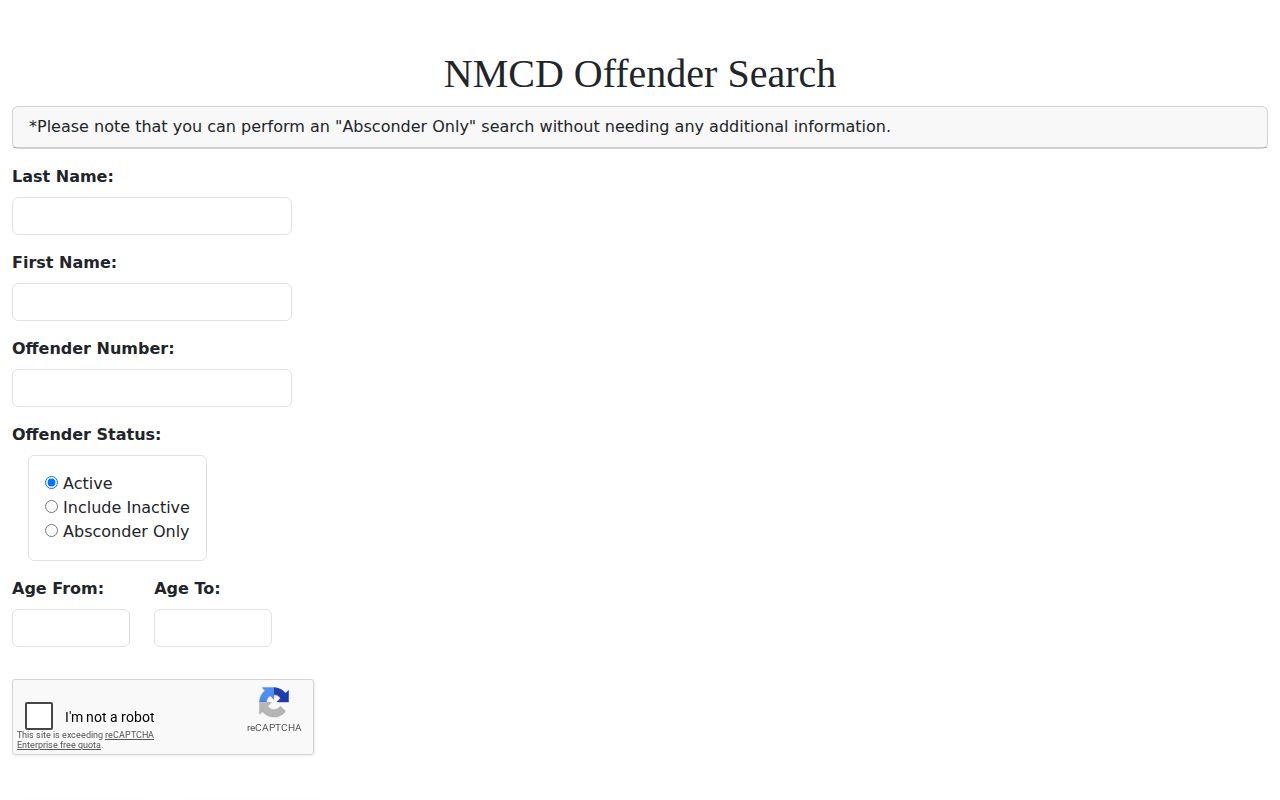
Selecting Include Inactive helps reach a former state record, but it does not search MCADC releases.
McKinley Release Court Records
Gallup's custody and court offices form a close local cluster, but each keeps a different part of the release story. MCADC is at 255 South Boardman Drive. Magistrate Court and Pretrial Services are listed at 285 Boardman Drive, while the Public Defender is at 285 South Boardman Drive. The McKinley County District Court is at 207 West Hill Avenue.
District Court handles felony matters. Magistrate Court handles felony preliminary hearings as well as misdemeanor, DWI, and traffic cases within its authority. Municipal Court covers applicable city ordinance and traffic matters. Search the New Mexico Courts Case Lookup, then confirm which court entered the order. The docket can retain the legal trail after jail custody ends, but it does not prove the minute when MCADC finished discharge.
McKinley Release Supervision Paths
A person released from state prison to parole can remain active in NMCD because active supervision is not incarceration. State parole and probation in McKinley County route through NMCD Gallup District Office 11A. A Crownpoint tribal case instead routes through Navajo Nation Probation Services. Identifying the court and sovereign comes before choosing a supervision office.
Note: Verify the supervising sovereign before relying on an office, because state and Navajo Nation cases use different local supervision paths.
Gallup Care After McKinley Release
Gallup's Behavioral Health Investment Zone and Na'Nizhoozhi network describe social detoxification, counseling, treatment, case management, shelter care, aftercare, and help coordinating appointments or transportation. These are local navigation options for people with those needs. The city does not identify them as an automatic MCADC discharge program, and release does not establish enrollment or eligibility.
Service access and legal supervision answer different needs. A person under NMCD or Navajo supervision must still follow directions from the proper office. A treatment, shelter, or transport resource does not replace those terms. Contact the provider to confirm the current service, intake route, and fit.
McKinley Release Alerts and BOP
VINE and VINELink provide event-focused custody information and alerts. Search for one identified person after selecting New Mexico, compare the result carefully, and register on the matched record. A release or custody-change notice reports what the participating source sent. It is not a permanent release archive. The official New Mexico VINE page also carried an NMCD service-upgrade warning at research time, so current service status must be checked before relying on a search or registration.
Federal prisoners committed to BOP use the BOP Inmate Locator, not NMCD. It covers records from 1982 forward and can show a past Release Date with “Released” or “Not in BOP Custody.” That result ends the BOP question only. It does not establish that supervised release ended or that no other sovereign later took custody. A federal pretrial person held at MCADC may remain with the U.S. Marshals Service and never yet have a BOP record.
McKinley Release or ICE Transfer
ICE explains that a detainer may ask another agency to notify ICE before release and keep custody for up to 48 additional hours so immigration officers can assume custody. That creates two accurate records at once: MCADC custody can end while detention continues under ICE. Check the jail destination field and the ICE Online Detainee Locator before describing the event as community release.
A 2019 ACLU of New Mexico report reproduced an MCADC policy effective in 2018 that distinguished DHS Form I-247 from a criminal warrant and directed staff to disregard immigration detainers. That document is historical evidence, not proof of 2026 policy. Request current facts from MCADC. The county's general statement that it contracts federal beds also does not prove a current ICE contract.
McKinley Release Destination Matters
MCADC's official page says the jail contracts bed space to federal, local, state, and tribal correctional agencies. This mixed use makes the committing authority central to every release search. A person can leave the same building for the community, NMCD, a federal custodian, or Navajo corrections. Request the destination or receiving agency instead of stopping at “not here.”
| Last system | Still in custody | Released or transferred record |
|---|---|---|
| MCADC | Call the jail for current presence | County booking/release or movement entry |
| NMCD prison | Active NMCD offender result | Include Inactive, NMCD case or discharge record |
| State parole/probation | Active supervision result | Inactive record or formal discharge |
| BOP | Institution shown in locator | Past Release Date and released location |
| ICE | Current ODLS match where available | Originating jail record and immigration case source |
| Navajo Nation | Navajo corrections or court confirmation | Tribal corrections record and court order |
Getting Home After McKinley Release
No official MCADC source publishes fixed release hours, an exit door, a family waiting area, property-return timing, or jail-provided transportation. Call the facility before traveling. A delayed order, transfer, or property process can change when and where a person exits.
Gallup Express lists a scheduled point at West Aztec and Boardman, which may be useful because MCADC is on South Boardman Drive. The transit operator publishes a $3 cash day fare with all-day transfers and a paid quarter-mile route deviation that must be arranged in advance. Those are public transit terms, not a jail release service. Confirm the current route at 505-722-0777 and get facility exit instructions from MCADC.
McKinley Detention Release Context
Local jail arrangements can shift as facilities change. A July 2025 Gallup Sun report described the current MCADC building as about 26 years old and discussed a four-phase renovation estimated near $15 million through 2026. It also reported staffing and budget figures from a city-council presentation. Those dated facts explain why contacts or physical arrangements may change, but they are not release totals and do not establish a release schedule.
McKinley County's detention history is older than the present center. A local cultural-history source says the 1938 Public Works Administration courthouse, opened in 1939, included a jail on its third floor. Historical location details should never replace the current MCADC contact or the modern county records process.
McKinley County Release Facilities
Two adult custody paths appear in the facility map. The McKinley County Adult Detention Center is the primary local jail. Its release evidence is the MCADC booking/release entry, the releasing court record, and any named receiving agency. The Crownpoint Adult and Juvenile Facility, also known within the Eastern Navajo Diné Justice Center, is a tribal facility. Adult release or transfer must be checked through Navajo corrections and the Crownpoint District Court, not treated as a McKinley County or NMCD record.
- McKinley County Adult Detention Center: community release, court-ordered release, or transfer to state, federal, tribal, or other custody.
- Crownpoint Adult and Juvenile Facility: adult tribal custody, Navajo court release, tribal probation, or transfer; juvenile information remains outside this public adult workflow.
Neither facility has a verified public release feed in the reviewed official channels. Direct records and the correct court remain the reliable path.